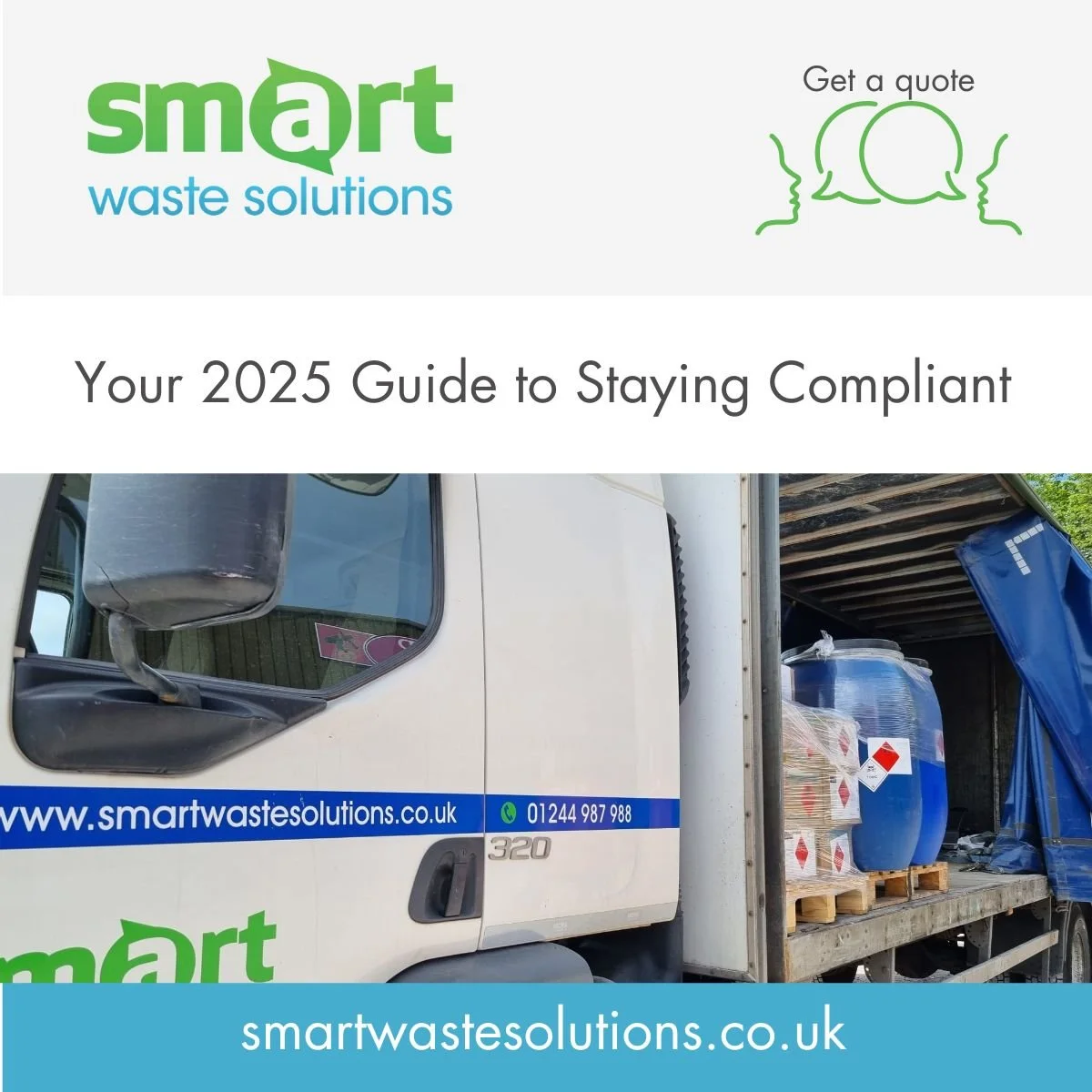
Your 2025 Guide to Staying Compliant
Welcome to 2025. Flying cars? Not yet. Robots doing the recycling? Sadly, no. But one thing we do have: stricter rules around hazardous waste disposal in the UK.
If you run a business in the North West of England (and beyond), you’ll know that hazardous waste isn’t just about ticking a box — it’s about keeping compliant, avoiding fines, and proving to customers that you take sustainability seriously.
So, grab a brew and let’s tackle this in a friendly Q&A — because compliance doesn’t have to be as painful as a dodgy bin liner splitting on a rainy day.
Q: What actually counts as “hazardous waste”?
A: Good question. Hazardous waste is anything that could harm people or the environment. Common examples for businesses in the North West include:
Paints, solvents, and oils from workshops.
Fluorescent light tubes from offices.
Cleaning chemicals from facilities.
Batteries (yes, even that overflowing drawer).
Asbestos in older buildings.
Old IT equipment full of hidden nasties.
If it could leak, burn, explode, or give the Environment Agency a headache — it’s hazardous.
Q: What’s new in 2025?
A: While the Hazardous Waste Regulations themselves haven’t changed much, enforcement is tougher. Regulators are cracking down on businesses that don’t:
Store hazardous waste properly (no “shove it in the corner and forget it” systems).
Keep consignment notes (paperwork is king).
Use licensed waste carriers (spoiler: that’s us).
Translation: if you’re cutting corners, fines in 2025 are bigger, faster, and more painful than ever.
Q: Why should businesses in the North West care?
A: Apart from avoiding fines that can run into the thousands? Compliance means:
Protecting staff and customers.
Meeting environmental and ESG targets.
Looking professional to clients.
Sleeping easier at night knowing your waste removal is 100% legal.
Q: So, how do I stay compliant with hazardous waste disposal?
A: Follow these five simple steps:
Identify what’s hazardous (don’t guess — get it assessed).
Segregate hazardous waste from general waste (no mixing).
Store securely in labelled containers.
Keep records — every movement needs a consignment note.
Use a licensed waste carrier (like Smart Waste Solutions), trusted across the North West.
Q: What mistakes do businesses usually make?
A: Oh, plenty…
Thinking paint tins are fine in general waste (they’re not).
Mixing hazardous waste with everyday rubbish.
“Forgetting” to keep paperwork.
Letting “Dave with a van” take it away (Dave isn’t licensed, and now you’re liable).
Q: This sounds like a lot of hassle. Can you handle it?
A: Absolutely. Smart Waste Solutions specialises in hazardous waste removal services across the North West and beyond. We’ll:
Collect hazardous waste safely.
Handle all consignment notes and paperwork.
Ensure you stay compliant and avoid fines.
Help your business reduce its environmental impact.
Q: Where do I sign up?
A: Easy, Contact Smart Waste Solutions for a free hazardous waste quote.
Final Word
Hazardous waste doesn’t have to be a headache. With the right licensed waste carrier (hi, that’s us), compliance is simple, safe, and cost-effective.
If your business is based in Manchester, Liverpool, Preston, Warrington, Chester, or anywhere else in the North West — or further afield — we’ll make sure your hazardous waste is disposed of legally, sustainably, and with zero stress.
Smart Waste Solutions — making hazardous waste less hazardous to your business.
